
DOCUMENTS

DOCUMENTS

DOCUMENTS

DOCUMENTS

Forest Reference Emission Level
In Misiones, Argentina, the Forest Reference Emission Level (FREL) is a key component within the Jurisdictional and Nested REDD+ Program (JNR), designed to quantify and establish a baseline of carbon emissions resulting from deforestation. This approach allows the province to develop effective incentives and protection measures for its native forests.
Aligned with international IPCC guidelines, the FREL employs an accounting method based on land use changes, leveraging remote sensing data and technologies like Google Earth Engine for precise analysis. This detailed analysis has allowed mapping of deforestation, regeneration, and forest degradation dynamics between 2009 and 2014, establishing an annual deforestation rate and providing a solid basis for conservation actions and sustainable management of Misiones territory. This detailed study has also made it possible to differentiate the different types of land use and cover, using Landsat images and advanced phenological and geomorphological analysis. As a result, the average carbon emissions for the analyzed period was calculated at 4,120,725 tons of CO2 per year.

Provincial Strategy for Emission Reduction from Deforestation and Degradation
The Provincial Strategy for Emission Reduction from Deforestation and Degradation (REDD+) of Misiones is an ambitious plan aimed at combating climate change through the preservation of native forests, which cover more than 50% of the provincial territory.
Through a comprehensive approach that seeks to reduce greenhouse gas emissions and promote sustainable development, the strategy aligns with global climate change mitigation and adaptation efforts.
With clear goals towards 2030, such as reducing deforestation and forest degradation, strengthening the system of protected natural areas, and implementing early warning systems, the strategy aims to contribute significantly to the fight against climate change.
It is guided by principles of good governance, including transparency, efficiency, and equity, and is structured around strategic axes that address everything from territorial planning to forest fire prevention, seeking low-carbon development that benefits the entire Misiones community.
Benefit Distribution Mechanism
The Misiones Jurisdictional REDD+ Program represents an innovative strategy for the conservation of native forests, financed through the commercialization of carbon credits in the international voluntary market.
Developed under the VERRA Jurisdictional and Nested REDD+ (JNR) Framework, this program seeks to reduce emissions derived from deforestation and degradation of forests, as well as provide direct and indirect financial benefits to forest owners, indigenous communities, and the Misiones community in general. With an inclusive approach, it considers the needs of small and medium-sized owners, as well as indigenous communities, promoting private sector participation and aligning with provincial and national environmental, social, and economic objectives.
The Benefit Distribution Mechanism (BDM) of the Misiones Jurisdictional REDD+ Program is a key financial structure designed to equitably allocate income obtained from the sale of carbon credits among the actors involved in forest conservation. This mechanism seeks to recognize and reward the environmental commitment of native forest owners and Misiones society in general, by strengthening provincial forest conservation policies. Through a transparent and supervised trust, the BDM ensures that funds are allocated to activities that promote sustainable development, climate change mitigation and adaptation, and social welfare, always respecting the principles of equity, citizen participation, and transparency.

Safeguards Information System
The document "REDD+ Safeguards Information System (SIS) of the Province of Misiones" details an innovative and participatory approach to the implementation of REDD+ Safeguards in the province, in line with global requirements for reducing emissions derived from deforestation and forest degradation.
It focuses on establishing a robust framework to ensure that REDD+ activities are environmentally and socially responsible, respecting the rights of indigenous peoples, promoting transparency and community participation, and ensuring biodiversity conservation.
This effort reflects Misiones' commitment to sustainable forest management and climate change mitigation, highlighting the development of a specific Safeguards Information System for the province (SIS-REDD+ Misiones), which systematizes efforts to apply safeguards through the Provincial REDD+ Strategy and the REDD+ ECO2 Program, ensuring effective monitoring and disclosure of how safeguards are addressed and respected during the implementation of REDD+ in Misiones.
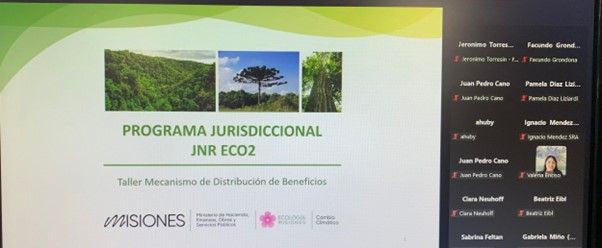
EPREDD Implementation Plan Version 2
The Environmental Services Benefits Program of the Province of Misiones called "ECO2", finds its legal foundation in Provincial Law XVI-103 on Payments for Environmental Services (PES). The REDD+ ECO2 Jurisdictional Program is the PES initiative for the protection of native forests in the province of Misiones. The province of Misiones is the first province in Argentina to explore this path as an innovative financing source to continue conserving its native forests.
The REDD+ ECO2 Jurisdictional Program (JNR ECO2 Program) is a public policy driven by the Provincial Government that seeks, through the protection of the Misiones Jungle, to access compensation for verified greenhouse gas (GHG) emission reductions. Its implementation is carried out under the Jurisdictional and Nested REDD+ (JNR) Framework 1 of the Verified Carbon Standard (VCS), applying Scenario 2 of carbon accounting and accreditation, which is administered by the international organization Verra.
The JNR ECO2 Program is developed within the framework of the Provincial REDD+ Strategy (EPREDD+), which constitutes the governing instrument for climate action regarding native forests in Misiones. The EPREDD+ defines the strategic axes, mitigation measures, and governance mechanisms that guide the reduction of emissions from deforestation and degradation of native forests. Within this framework, the Program acts as an implementation vehicle, through which it is operationalized as a financing mechanism and benefit channeling.
The EPREDD+ (Provincial REDD+ Strategy) aligns with the National REDD+ Strategy known as the National Action Plan for Forests and Climate Change (PNAByCC) and with the National Plan for Adaptation and Mitigation to Climate Change (PNAyMCC), and at the provincial level with the Provincial Response Plan to Climate Change (PRPCC) of the State Secretariat of Climate Change (SECC), as well as with the Strategic Plan for Native Forests of the Province 2022-2032.
The EPREDD+ seeks to contribute to GHG mitigation through sustainable forest management, the increase and conservation of forest carbon reservoirs, the development and execution of plans, measures, and actions, which are incorporated into instruments for sustainable development, becoming a planning and management instrument that determines, guides, and prioritizes strategic actions for the implementation of REDD+ in the territory.
Legal Framework of the Jurisdictional REDD+ Program Misiones, Argentina
In this section you can access the "Legal Framework" document that presents the arguments supporting the creation of the JNR program. Among these arguments are:
- National constitutional background
- Provincial constitutional background
- National laws on minimum budgets and territorial planning of native forests
- Provincial law on payments for environmental services
- National REDD+ program background in which subnational governments have participated.
It also explains the reasons why the program does not violate the rights of native forest owners.